
A. Introduction (About the Author and Book)
About the Book
"The Human Loop" is a book that presents the reader with a narrative story intertwined with a research experiment. It is an attempt to bridge the gap between cold, alienating Quantum Physics and the warm, chaotic human experience. The book is built as an interactive website. It is recommended to read the chapters in order. At the same time, you can access the findings of the full research - the "Reflective Time Model" - at any time, or navigate between the research and the narrative story via the floating circles located on the sides of the browser page (red and green) ...
Book Structure
The book is built from 5 parts containing 15 plot-driven narrative text chapters of the story titled "The Human Loop". Each chapter contains at its head a green box with definitions of the scenarios in that chapter itself. The chapters are accompanied by rich media and historical sources (videos, animations, audio, podcasts, images, PDF files, etc.). From every chapter there is the option to go to the full research by clicking the floating button of the full research (the red circle), as well as to access findings, appendices, or the various archives ...
The Author and the Book's Structure
When numbers stop being a coincidence - Time needs a new model
Since time immemorial, there is a common truth we all absorbed "naturally" without needing profound explanations: The past has happened and passed, the present exists right now, and the future has yet to come.
This book was written the moment I met the revolutionary idea of Eran Harpaz, who, at a certain point in his life's journey, discovered that this assumption ceased to align with both scientific findings and his personal experience.
the spark, the heart, and the revolutionary idea of the "Reflective Time Model" (RTM)
were conceived, developed, and created by my son - Eran Harpaz,
who diligently worked for many months on the loops, calculations, closures, and proofs
in all the structures, scenarios, and events in this fascinating, revolutionary, and innovative book.
H.A ~
The characters you'll meet - Professor Eliyahu Shalom, Michal and Avi - are fictional. But the calculations, gematria values, and anchors they uncover on their journey - are not fictional at all. Every formula you see in the plot is grounded in the same scientific-mathematical methodology documented in the real R.T.M research, the one Eran investigated for many long months.
The story is a simulation; the numbers - are real.
> What you will see in the coming minutes is not a theory, but a record of an experiment.
The globe above you isn't just spinning — it is counting down."
> Recovery Status: 14 log chapters + findings box.
📂 Part One: The Plot
The amazing, fascinating, and narrative story about Professor Eliyahu Shalom and his students Michal and Avi
A breathtaking plot that crosses the boundaries of time and space: from the dark halls of the university, through dangerous quantum leaps, to hair-raising chases in the streets of Tel Aviv in the 1990s.
Yet the boundaries of time are broken for them – the plot leaps forward, touching events and scenarios from the 2000s, from the twin towers disaster to modern cultural symbols. It all unfolds in a desperate attempt to escape hostile forces seeking to rewrite history and bring about the collapse of reality as we know it.
📂 Part Two: Findings of Examples and Calculations
Part Two leaves the framework of the story and addresses the reader directly. Here, key findings uncovered in the research are presented one after another: a focused collection of numerical case files - from major historical events to personal anchors - each proven through simple arithmetic tools that the connection is not coincidental.
📂 Part Three: Epilogue
The part that concludes the journey - not as a solution, but as an invitation. The Professor, Michal, and Avi reach a point where the question is no longer "is the model correct," but "what do we do with this knowledge." This is the moment where the fictional story parts ways with the real research - leaving the reader alone with the numbers, with an open question: if time truly organizes itself, what does that mean for the very moment you are in right now?
📂 Part Four: Scientific Appendices
For those who want to go deeper - here are gathered the original documents of the R.T.M research: the full methodology, statistical testing rules (including Monte Carlo tests), and the protocol by which every finding is checked before approval. This is the part that turns the book from a literary experience into a research document that can be independently examined - for those who want to check the method, not just the result.
📂 Part Five: Conclusion and Further Reading - Archives
The Findings Archive - a reference box for the 15 chapters.
The Sources Archive - R.T.M.
The Appendices Archive - scientific appendices, and access to the hidden vault.
The Full Media Archive - chapter selection for viewing.
The Forbidden Archive - classified materials.
Who is this book for? For those who feel that the world is logical, but not entirely. For those who believe in science, but feel that the existing equations leave too much to coincidence.
Below is a document summarizing the research, empirical, and methodological framework of the R.T.M (Reflective Time Model), as it has developed from a broad body of documented findings. The model investigates the connections between events, information, records, the act of documentation and observation, time, and the observer's identity, and examines how data from different sources and points in time organize into precise, recurring, and converging structures. This document consolidates the principles of R.T.M, its measurement methods, testing rules, and validation framework through which the phenomenon is examined as a single structured system.
"Time does not just flow – it organizes.
What organizes aligns, and what aligns – closes."
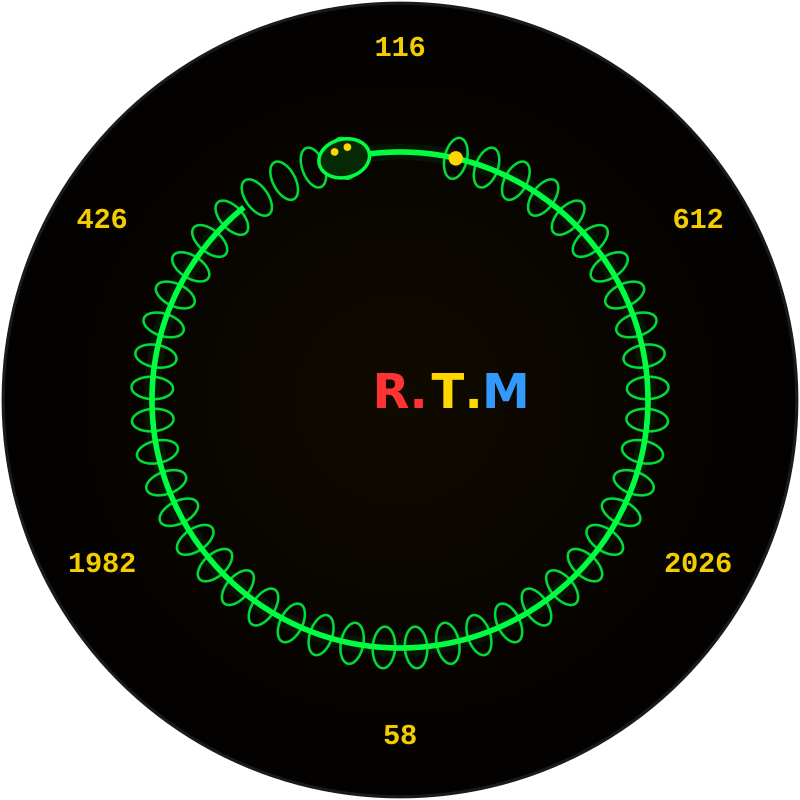
// LOCATION: Tel Aviv University (Grid 32.11) //
// ANOMALY DETECTED: Time Lag //
// STATUS: Awaiting input...
1. The Void
The October rain didn't just fall that evening; it hammered. It struck the dark panes of Hall 303 in the Shenkar Physics building like thousands of small, freezing, desperate fingers trying to get in. It was Tuesday, seven minutes past eight in the evening, and the university was almost entirely empty. The long, polished corridors, usually buzzing with rushing students and the noise of coffee machines, stood silent, bathed in a sickly, yellowish fluorescent light.
We were the remnants. A small group of seven students enrolled in an elective course with the vague title "Paradoxes in Time and Complex Systems". None of us truly understood the syllabus, but the rumors about Professor Eliyahu Shalom were strong enough to draw us in. They said he was a genius who had lost his way. They said he had cracked something that was forbidden to crack. But this evening, his chair was empty.
That was the first sign that something was off-balance. In the three years I've studied here, Professor Shalom had never been late. He was a man who lived by the atomic clock; precision was his religion, and entropy was the enemy. He usually entered the class at exactly 19:55, erased the board with measured strokes, and arranged his papers in a perfect symmetrical pile, parallel to the edge of the desk. But tonight, the board remained smeared with the chemical equations of the previous lecturer, and the podium stood orphaned. Grains of dust danced in the beam of the projector that was left on for no reason, illuminating a blank blue screen.
"He's not coming," Avi said. He sat one row ahead of me, leaning back in the uncomfortable plastic chair, twirling a silver metal pen between his fingers. The click-clack of the pen was the only sound in the room besides the monotonous drumming of the rain. "Waste of our time. Let's cut."
Michal, sitting in the darkest corner of the hall, looked up from her laptop. The bluish light of the screen reflected in her glasses, hiding her eyes, but her voice was sharp. "He will come, Avi. He's just... delayed."
"Delayed?" Avi scoffed, but the smile didn't reach his eyes. He was nervous. We all were. There was a feeling of static electricity in the air, as if a storm was about to break inside the room, not outside. "Did you hear what happened on floor minus one two hours ago?"
No one answered. Avi continued, lowering his voice to a dramatic whisper. "The quantum lab servers. They say there was a voltage drop that burned three processors. But the technician said it wasn't a short circuit. He said the processors just... reset. As if someone physically erased their memory."
I wanted to tell Avi he watches too many sci-fi movies, that the real world is much more boring, and that Professor Shalom was probably just stuck in traffic on the Ayalon Highway in this rain. I opened my mouth to speak, but then the door opened. No, it didn't open – it was slammed against the wall.
2. The Entrance
Professor Shalom stood in the doorway. For a moment, I didn't recognize him. The man who always wore crisp, tailored suits now looked like the survivor of a natural disaster. His gray coat was soaked, dripping a dark puddle that was expanding on the light linoleum. His gray hair, usually combed back neatly, was disheveled and plastered to his forehead with cold sweat. His bag hung haphazardly over his shoulder, half-open, papers peeking out as if they'd been shoved in a hurry.
But the eyes... those were the eyes that frightened me. They darted around the room, scanning every corner, every window, every shadow, as if he hadn't entered a classroom to teach, but was looking for a bunker to hide in. He stepped inside and slammed the door behind him. The key turned in the lock with a sharp metallic clack. We were locked in.
"Good evening?" I tried to ask. My voice came out hesitant, swallowed by the space of the room.
He didn't answer. He limped toward the board, completely ignoring us. He grabbed the eraser and wiped away the chemical equations with violent, broad strokes, leaving a wet trail on the green board. Then he took a piece of white chalk. His hand was shaking so much that the chalk snapped with a loud crack the moment it touched the surface. A small piece flew to the floor. He didn't stop. With the broken piece left in his hand, he wrote three large, crooked, and screeching letters:
He stood there for a moment, his back to us, his shoulders rising and falling with heavy breaths. Then he turned around. "Forget what you knew," he said. His voice was hoarse, low, as if he hadn't spoken for days. "Forget Newton. Forget the second law of thermodynamics. Forget Einstein."
He approached the first row, leaning with both hands on Avi's desk. Avi recoiled, the pen slipping from his hand and rolling onto the floor. "They taught you that time is a river," the Professor whispered, and a strong scent of rain, dampness, and fear emanated from him. "That it flows from one place – the past, to another place – the future. That you cannot step into the same river twice. A lie. It's all a lie."
He straightened up and pointed to the letters on the board. "Time is not a river, ladies and gentlemen. Time is a wave. And what happens to a wave when it hits an opaque wall?"
He turned to us. "Forget what you knew," he said, his voice hoarse. "They taught you that time is a river flowing forward. A lie. Time is a spiral repeating itself."
"Do you see this?" he pointed to the numbers. "This isn't history. This is code. In 2600 BC, the Egyptians built stone triangles. In 73 AD, Masada fell. In 1830, the American poet Emily Dickinson was born. And in 1886, Emily Dickinson died. Seemingly, no connection. But in the RTM model..."
He drew an aggressive line between the four dates. "This is the same point on the wave. These are the first anchors. Extreme moments of human entropy. The system built the pyramids and gave birth to Emily Dickinson in order to fix time, and burned Masada and killed Emily Dickinson of nephritis in order to reboot them. We are not looking for events, ladies and gentlemen. We are looking for the pulse between them."
He approached the first row, leaning with both hands on Avi's desk. "And now, we are going to see if this pulse is still beating."
He looked at me. I felt he was waiting for an answer. "Does it... bounce back?" I stammered. "Does it reflect?"
"Exactly," the Professor smiled, but it was a broken smile. "It reflects.
Reflexive Time Model.
Our reality is not a one-time projection. It is an echo. It is an endless repetition of data colliding with the wall of reality and bouncing back to us."
3. The Experiment
He returned to the lecturer's desk and pulled a small black box out of his wet bag. A red light blinked on it at an irregular rhythm, like the pulse of a dying animal.
"We are going to conduct an experiment," he announced. "We are going to prove that the future has already happened, and that what we experience as the 'present' is merely the system's memory trying to correct itself."
"I need numbers," he commanded. "Don't think. Just throw them out. The system needs random input."
Silence fell over the classroom. I looked at Michal. Her face was pale.
"Come on!" he shouted, and the lights in the classroom flickered. "Give me data!"
" 24," Avi blurted out. "Today's date."
" 1985," Michal said. Her birth date.
I felt a pressure in my chest. "Seven," I said. Just a number.
The Professor typed the last digit. His finger hovered, trembling over the ENTER key. He pressed it.
The box emitted a harsh buzzing sound. The large screen on the wall flickered. And then, everything stopped. The screen was painted in bright green. One number appeared on it. Large. Stable. Impossible.
"This makes no sense. The probability is one in a billion," Michal whispered.
"Probability is dead," the Professor said. "The cycle has closed."
refusing to fade.

Who deliberately triggered the Masada loop 25 years ago, and the horrifying realization that the number 1985 wasn't a glitch—it was a warning.
Want to read Chapter 2 for free?
Already bought the book?
Open the email you received from Gumroad and click the link in it — the book opens straight away, with nothing to type.
Can't find the email? Enter your purchase code here: